Currently Empty: R0.00

Reverse Osmosis Recovery Rate Explained: How to Maximise Efficiency Without Damaging Your System
Reverse osmosis recovery rate explained is a topic that every RO system owner should understand. Whether you operate a residential purifier, a commercial water treatment plant, or a large industrial reverse osmosis system, the recovery rate directly affects water production, operating costs, membrane performance, and overall system efficiency.
Many people assume that increasing recovery always improves efficiency because less water is sent to drain. However, running an RO system at an excessively high recovery rate can increase scaling, membrane fouling, and maintenance costs. On the other hand, setting the recovery rate too low wastes water and reduces system efficiency.
Finding the correct balance is essential. In this guide, you’ll learn what the recovery rate is, how it is calculated, what factors influence it, and how to optimise it for reliable long-term performance.
What Is a Reverse Osmosis Recovery Rate?
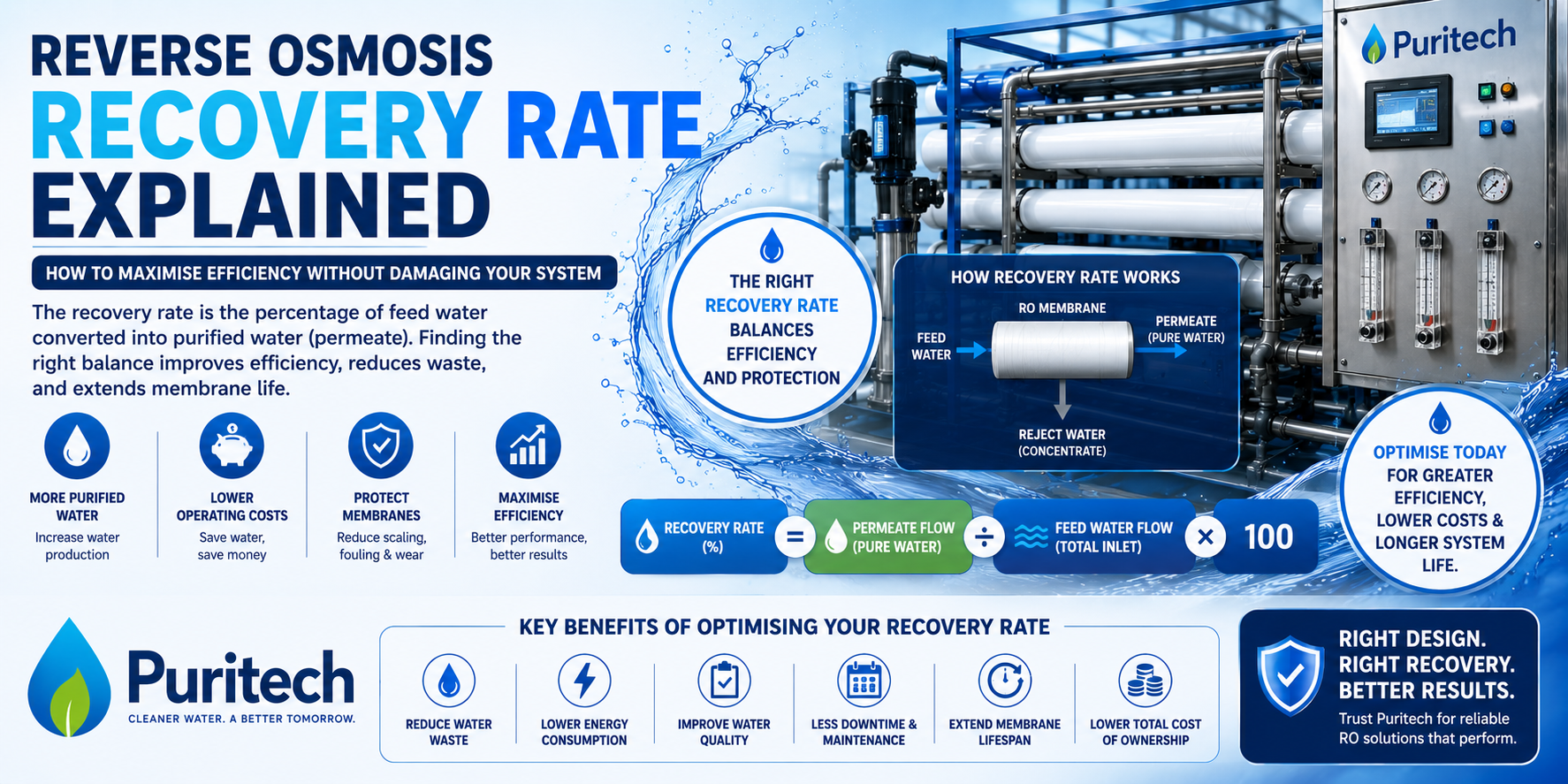
The reverse osmosis recovery rate is the percentage of feed water converted into purified water, known as permeate.
The remaining water, called concentrate or reject water, carries away the dissolved salts and contaminants removed by the membrane.
For example:
- Feed water: 1,000 litres per hour
- Permeate: 750 litres per hour
- Reject water: 250 litres per hour
The recovery rate is:
750 ÷ 1,000 × 100 = 75%
This means 75% of the incoming water becomes purified water, while 25% leaves the system as concentrate.
Understanding this calculation is the first step toward improving RO system efficiency.
Why Recovery Rate Matters
The recovery rate influences almost every aspect of an RO system’s performance.
A properly designed recovery rate helps:
- Maximize water production.
- Reduce water waste.
- Protect membranes from scaling.
- Improve energy efficiency.
- Maintain water quality.
- Extend membrane lifespan.
- Lower operating costs.
- Reduce cleaning frequency.
Selecting the correct recovery rate requires balancing water efficiency with membrane protection.
Factors That Affect Recovery Rate
Several factors determine the maximum safe recovery rate for an RO system.
Feed Water Quality
Water with high levels of dissolved minerals, hardness, silica, or suspended solids generally requires lower recovery rates to reduce the risk of scaling and fouling.
Membrane Design
Different membrane models have different operating limits. Always follow the manufacturer’s recommendations.
Pretreatment Quality
Effective pretreatment removes contaminants before they reach the membrane, allowing higher recovery rates in many applications.
Operating Pressure
Pressure affects permeate production and overall system performance. However, increasing pressure alone does not guarantee better recovery.
Water Temperature
Warmer water generally passes through membranes more easily than colder water, influencing system output and recovery.
Typical Recovery Rates
| Application | Typical Recovery Rate |
|---|---|
| Residential RO | 20–50% |
| Commercial RO | 50–75% |
| Industrial RO | 65–85% |
| Seawater RO | 35–50% |
| Brackish Water RO | 70–85% |
These values vary depending on water quality, pretreatment, and system design.
Problems Caused by Low Recovery Rates
When recovery is too low, the system may:
- Waste large amounts of water.
- Increase water costs.
- Require larger storage tanks.
- Reduce overall efficiency.
Although membrane protection improves, operating costs may rise due to excessive reject water.
Problems Caused by High Recovery Rates
Increasing recovery beyond the system’s design limits can lead to the following:
- Scale formation.
- Membrane fouling.
- Higher operating pressure.
- Reduced permeate quality.
- More frequent chemical cleaning.
- Shorter membrane life.
- Higher maintenance costs.
The goal is to maximize recovery without exceeding the membrane’s operating limits.
How to Optimise Your Reverse Osmosis Recovery Rate
Optimizing your reverse osmosis recovery rate is about finding the right balance between water efficiency and membrane protection. Every water source is different, so there is no single recovery rate that suits every application.
Before increasing recovery, it’s important to understand the quality of your feed water and ensure your pretreatment system is performing correctly. A properly designed RO system can achieve excellent recovery while maintaining high water quality and protecting the membranes from premature failure.
The following strategies can help improve recovery safely.
1. Start with a Comprehensive Water Analysis
A detailed water analysis is the foundation of every successful reverse osmosis system.
Testing should include:
- Total Dissolved Solids (TDS)
- Hardness
- pH
- Silica
- Iron
- Manganese
- Turbidity
- Silt Density Index (SDI)
- Chlorine
- Microbiological contaminants where applicable
Knowing the composition of the feed water allows engineers to design an RO system with an appropriate recovery rate and pretreatment process.
2. Install Effective Pretreatment
Pretreatment plays a vital role in achieving higher recovery rates.
Depending on the feed water, pretreatment may include the following:
- Multimedia filtration
- Sediment filters
- Activated carbon filters
- Water softeners
- Ultrafiltration systems
- Antiscalant dosing
- UV sterilisation for specific applications
Removing contaminants before they reach the RO membranes reduces fouling, scaling, and pressure loss, allowing the system to operate more efficiently.
3. Control Scaling
As recovery increases, dissolved minerals become more concentrated in the reject stream. If these minerals exceed their solubility limits, they can form scale on the membrane surface.
Common scale-forming minerals include:
- Calcium carbonate
- Calcium sulphate
- Barium sulphate
- Strontium sulphate
- Silica
Using antiscalants, water softeners, or adjusting recovery rates can help prevent scaling and protect the membranes.
4. Maintain Stable Operating Pressure
Operating pressure directly influences permeate production. However, increasing pressure beyond the system’s design limits can accelerate membrane wear and increase energy consumption.
Monitor pressure regularly and investigate sudden changes, as they may indicate fouling, scaling, or blocked filters.
5. Monitor System Performance
Routine monitoring is essential for maintaining the correct recovery rate.
Track the following parameters:
- Feed flow
- Permeate flow
- Reject flow
- Operating pressure
- Differential pressure
- Permeate conductivity
- TDS
- Recovery percentage
Keeping accurate records makes it easier to identify performance trends and respond before problems become serious.
Balancing Water Recovery and Water Quality
Maximizing water recovery should never come at the expense of water quality.
A system operating at an excessively high recovery rate may produce more purified water initially. However, increased scaling and membrane fouling can eventually reduce water quality, increase maintenance costs, and shorten membrane life.
In many cases, operating at a slightly lower recovery rate provides better long-term performance and lower overall operating costs.
The most efficient RO system is one that consistently produces high-quality water while maintaining reliable operation over many years.
Recovery Rate and Different Water Sources
Different water sources require different recovery strategies.
Municipal Water
Municipal water generally allows higher recovery rates because it has already undergone treatment to remove many suspended solids and microorganisms.
However, chlorine must still be removed before it reaches the RO membranes.
Borehole Water
Borehole water often contains higher concentrations of dissolved minerals such as calcium, magnesium, iron, and manganese.
Additional pretreatment may be required to prevent scaling and achieve acceptable recovery rates.
Surface Water
Water from rivers, dams, and lakes frequently contains suspended solids, algae, and organic matter.
Pretreatment systems such as multimedia filtration and ultrafiltration are often necessary before reverse osmosis.
Brackish Water
Brackish water typically allows higher recovery rates than seawater but may still require antiscalants and specialised pretreatment to control scaling.
Seawater
Seawater reverse osmosis systems operate under much higher pressures and generally achieve lower recovery rates because of the high salt concentration.
Careful system design is essential to protect membranes and optimize performance.
Common Recovery Rate Mistakes
Many RO systems perform below their potential because of avoidable errors.
Increasing Recovery Without Water Testing
Changing recovery settings without understanding the feed water chemistry can lead to rapid membrane scaling and expensive repairs.
Ignoring Seasonal Water Quality Changes
Feed water quality may change throughout the year due to rainfall, drought, or municipal treatment adjustments.
Recovery rates should be reviewed when significant changes occur.
Poor Pretreatment Maintenance
Blocked cartridge filters, exhausted activated carbon, or neglected multimedia filters reduce overall system performance and increase membrane fouling.
Routine maintenance remains essential.
Focusing Only on Water Savings
Reducing reject water is important, but excessive recovery can increase operating costs if membranes require more frequent cleaning or replacement.
The goal is long-term efficiency rather than short-term water savings.
Frequently Asked Questions
What is the ideal recovery rate for a reverse osmosis system?
The ideal recovery rate depends on feed water quality, membrane design, and pretreatment. Most commercial systems operate between 50% and 75%, while many industrial systems achieve 65% to 85% under suitable conditions.
Does a higher recovery rate always mean a better system?
No.
A higher recovery rate may improve water efficiency, but if it causes scaling or membrane fouling, it can reduce overall system performance and increase operating costs.
Can recovery rates be adjusted after installation?
In many systems, recovery rates can be adjusted. However, changes should only be made after reviewing water quality, operating conditions, and membrane manufacturer recommendations.
How does pretreatment improve recovery?
Pretreatment removes contaminants that contribute to membrane fouling and scaling, allowing the RO system to operate at higher recovery rates while maintaining reliable performance.
What happens if recovery is too high?
Excessively high recovery rates increase the concentration of dissolved minerals inside the system. This can lead to scaling, membrane fouling, reduced permeate quality, and shorter membrane life.
Final Thoughts
Understanding reverse osmosis recovery rates is essential for achieving the right balance between water efficiency and membrane protection. While maximizing purified water production is important, pushing a system beyond its design limits can result in increased maintenance, higher operating costs, and reduced membrane lifespan.
The best-performing RO systems are those designed around accurate water analysis, effective pretreatment, and continuous performance monitoring. By selecting an appropriate recovery rate and maintaining the system correctly, you can improve water quality, reduce waste, and extend the life of your investment.
Whether you’re installing a new reverse osmosis system or looking to optimize an existing one, Puritech can help you assess your water quality, recommend the right recovery strategy, and provide tailored water treatment solutions for residential, commercial, and industrial applications.